What the May 2022 Derecho Taught Guelph Homeowners
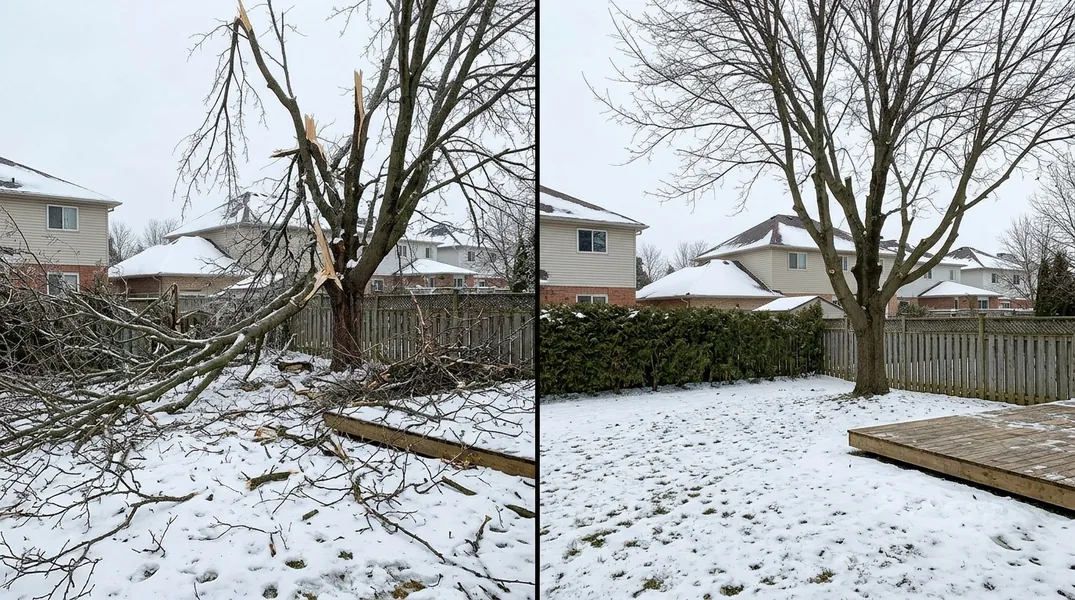
On May 21, 2022, a derecho swept across Ontario with wind gusts that reached well over 100 km/h in some areas. Unlike a tornado, a derecho is a long-lived, fast-moving line of severe thunderstorms that can travel hundreds of kilometres, leaving a broad trail of wind damage trees ontario residents still talk about. In Guelph, mature maples, oaks and spruces came down on lawns, driveways, fences and roofs within minutes. The cleanup took weeks, and many homeowners learned a hard lesson: the trees that failed were often the ones that had been showing quiet warning signs for years.
The storm did not simply target weak trees at random. It exposed structural flaws that had developed slowly, including co-dominant stems with weak unions, decay hidden inside trunks, shallow root plates lifted by years of soil compaction, and heavy limbs that had never been reduced. A tree risk assessment performed before storm season can identify those flaws while there is still time to act. At Guelph Tree Trimming Co., our ISA Certified Arborists regularly evaluate trees in neighbourhoods like West Willow Woods (Guelph) and Parkwood Gardens (Guelph), where mature canopies sit close to homes and hydro service lines.
Warning Signs of a Storm-Prone Tree
Most storm failures announce themselves long before the wind arrives. A leaning tree guelph homeowners often dismiss as a curiosity is one of the clearest signals: a new lean, especially one that appeared after heavy rain or a freeze-thaw cycle, can mean the root plate is shifting. Other red flags include cracks or seams in the trunk, mushrooms or conks growing at the base, cavities, dead branches in the upper canopy, and included bark where two stems meet in a tight V. Any of these suggests the tree deserves a closer look from a qualified arborist.
Species matters too. Silver maples, willows and poplars grow fast and break easily. Spruces with shallow root systems tip over in saturated Ontario clay. Even strong hardwoods like oak and maple become hazardous when they carry heavy end weight on long horizontal limbs. Regular Tree Pruning that removes deadwood and reduces leverage on vulnerable limbs is one of the most effective ways to make a tree more wind-resistant. Thinning the canopy selectively, rather than topping it, lets wind pass through instead of catching the crown like a sail.
Why Some Trees Fail and Others Stand
The difference between a tree that survives a derecho and one that comes down usually comes down to structure and site conditions. Trees growing in compacted soil, surrounded by pavement, or planted too deeply often develop poor root systems that cannot anchor them in a windstorm. Construction damage, lawn mower wounds and years of improper pruning all create entry points for decay. When a storm arrives, the weakest point gives way, sometimes bringing down a limb the size of a small tree.
Proactive care changes the outcome. Cabling and bracing can support a valuable tree with a weak union. Crown reduction on a heavy, overextended limb lowers the risk of failure without removing the tree. And when a tree is already compromised beyond saving, a planned Tree Removal performed in calm conditions is far safer and less expensive than an emergency tree removal guelph call at the height of a storm. Our crews document the condition of each tree so homeowners understand their options before severe weather forces the decision.
Building a Storm-Ready Yard Before the Next Big Wind
Storm readiness starts with a walk around your property each spring and fall. Look up: are there dead limbs hanging over the roof or driveway? Look down: is the soil heaving or cracked near the base of a large tree? Look at the trunk: any cracks, seams or fungal growth? If something concerns you, book a tree risk assessment rather than waiting for the next forecast. An arborist can rate the likelihood of failure and recommend pruning, cabling or removal based on the tree's target, meaning what it would hit if it fell.
Keep trees well watered during dry spells, avoid piling soil or mulch against the trunk, and never park heavy equipment under the canopy. If a limb does come down, do not attempt to cut it yourself if it is touching or near a hydro line. Our crews work only on clearance around the customer's private service entrance, the wire from the pole to the house, and always respect safe approach distances. For anything on the public distribution network, contact your local utility or Hydro One. Once the debris is cleared, Stump Grinding removes the leftover hazard and lets you replant with a better-suited species.
When to Call a Professional After a Storm
After a major wind event, some damage is obvious: a tree on the roof, a split trunk, a limb blocking the driveway. Other damage is subtler, such as a cracked union that has not yet separated or a root plate that has lifted a few centimetres. Both are dangerous to leave. If a tree is leaning toward a structure, has fresh cracks, or has lost a major limb, keep people and pets clear and call a professional. Do not stand under the canopy to take photos, and do not run a chainsaw near a limb under tension.
Guelph Tree Trimming Co. provides storm damage tree removal guelph homeowners can rely on, with fully insured crews and clear rates before work begins. We serve Onward Willow (Guelph) and the surrounding neighbourhoods, and we can document the damage for your insurer if a claim is needed. To arrange a free estimate or an emergency assessment, call (226) 829-5459 or request a free quote online. A little preparation now is far easier than cleanup after the next big wind.
Looking for a professional in Guelph? Guelph Tree Trimming Co. responds quickly for all your tree trimming needs.
Get a free estimateOur services : Tree Trimming · Tree Removal · Stump Grinding