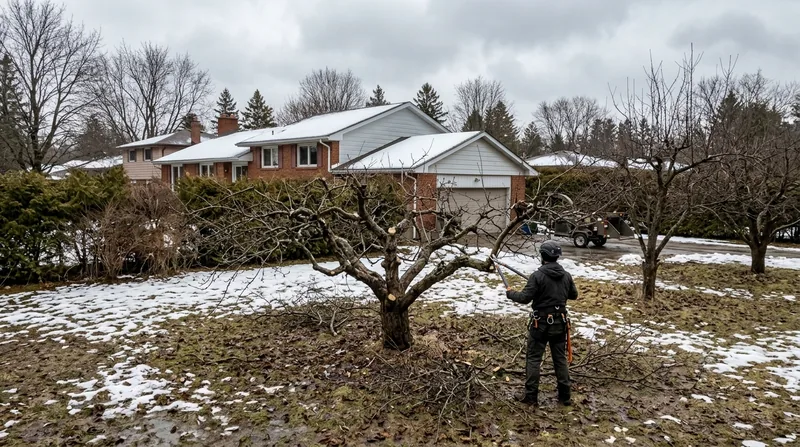




Fruit trees in Guelph carry a lot of weight. A mature apple or pear in a backyard off West Willow Woods can produce hundreds of kilograms in a good year, and a plum or cherry left unpruned for a decade turns into a tangle of crossing limbs, water sprouts and black knot. Fruit tree pruning in Guelph is the work that keeps that production steady, the canopy open and the tree structurally sound through ice storms and summer windstorms. Our ISA Certified Arborists have pruned backyard fruit trees across the Guelph area since 2015, from century-old apple trees on ravine lots to young pear trees planted three seasons ago. We work in dormancy, we make clean cuts at the branch collar, and we leave the property tidy. If you are comparing companies, start with a look at our tree pruning service to see how we handle structural work on shade trees as well.
Why fruit trees need structural pruning, not just a haircut
A fruit tree is not a shade tree. It is grown for fruit, which means light has to reach the interior of the canopy, air has to move through it, and the wood has to hold the weight of a crop plus rain plus ice. Left alone, apple and pear trees produce upright water sprouts that shade out fruiting wood, and plum and cherry trees develop black knot on infected branches that spreads if it is not cut out. Correct pruning balances vigour and fruit, and it removes the weak crotches that fail under snow load.
- We open the centre of the canopy so sunlight reaches the lower fruiting branches.
- We remove dead, damaged and crossing limbs before they rub bark and create entry points for disease.
- We cut out black knot on plums and cherries well below the visible swelling, and we dispose of the infected wood.
- We thin the crop on heavy-bearing apples and pears so branches do not snap under the weight.
- We correct the structure of young trees so the scaffold limbs are well spaced and strong.
That combination is what separates a pruned fruit tree from a sheared one, and it is the reason a neglected apple tree can be brought back into production over two or three seasons.
Key fact: a mature apple tree in a Guelph backyard that has not been pruned in eight to ten years typically needs two to three hours of structural work, plus the removal of several hundred kilograms of brush. We chip that brush on site and can leave the chips for your garden beds.
How we prune a fruit tree, step by step
Every fruit tree we work on gets the same sequence, whether it is a single plum in Parkwood Gardens or a row of pears along a fence line in Centre Wellington. We start with the structure and the health of the tree, then move to the fruiting wood, then clean up. The order matters: cutting the canopy first and the structure last leaves the tree unbalanced and the job unfinished.
- We assess the tree from the ground and, where needed, from within the canopy, checking for cracks, included bark, rot and old pruning wounds.
- We remove dead, diseased and broken limbs first, cutting back to healthy wood.
- We thin and reduce the structural limbs to open the canopy and lower the height where the tree has outgrown its space.
- We cut out black knot and any cankers, sterilizing tools between cuts.
- We shape the remaining fruiting wood, leaving enough lateral branches for next season's crop.
- We chip the brush, rake the lawn and blow the driveway and walkways clean.
For trees that have been badly neglected, we spread the work over two dormant seasons so the tree is not pushed into excessive regrowth.
Key fact: a plum tree with black knot in Onward Willow is a common call in late winter. Cutting the knots out in dormancy, before the spores spread in spring, is the most effective cultural control available. We remove the infected wood from the property the same day.
Methods we use and when they apply
Not every fruit tree needs the same treatment. A young tree is trained, a mature tree is renewed, and an old tree in decline is managed carefully to avoid shocking it. The table below sets out the methods we use and the situations they suit.
| Method | Description | Context |
|---|---|---|
| Structural pruning | Selecting and spacing scaffold limbs, removing weak crotches and included bark | Young to mid-age apple, pear, plum and cherry trees |
| Canopy thinning | Removing a portion of interior branches to improve light and airflow | Dense, overcrowded canopies that fruit poorly |
| Renewal pruning | Cutting back old, unproductive limbs to stimulate new fruiting wood | Neglected or overgrown trees, spread over two seasons |
| Disease removal | Cutting out black knot, cankers and fire blight strikes with sterilized tools | Plum and cherry with black knot, apple and pear with fire blight |
| Crop thinning | Removing excess fruit so limbs are not overloaded | Heavy-bearing apple and pear trees in summer |
We choose the method based on the species, the age of the tree and what you want from it, whether that is a harvest for the table or a tree that stays manageable in a small yard.
Timing: why late winter is the window
Fruit trees are pruned in dormancy, from late fall through late winter, and the best window in the Guelph area is usually February into early March, before buds break. The tree is fully dormant, the structure is visible without leaves, and wounds close quickly once growth starts. Pruning in late winter also avoids the risk of fire blight infection, which is much higher when cuts are made during active growth in warm, wet weather. Summer pruning is limited to light thinning and crop adjustment, plus the removal of water sprouts.
There are exceptions. Black knot on plums and cherries can be cut out whenever it is found, but dormant removal is preferred so spores are not released during the growing season. Dead wood can come out any time of year. If a limb has broken under a summer storm, we remove it promptly to limit tearing and decay.
Book early. The dormant window is short, and February fills up quickly across Guelph, Centre Wellington and Mapleton.
Working around the property and the rules
Most fruit trees in Guelph sit in backyards, often behind a standard gate or along a fence line, and some are on ravine lots with steep access. We plan the work around the property: we protect lawns with plywood or tarps, we keep the work area clear of people and pets, and we avoid dropping limbs onto fences, sheds or neighbouring yards. Where a tree is close to a private electrical service entrance, we respect the required approach distances and coordinate with your local utility or Hydro One if the service needs to be temporarily disconnected. We never touch the public distribution network; a tree in contact with public lines is referred to your local utility or Hydro One.
The City of Guelph may require a permit for a private tree removal, and the application is normally supported by an arborist report. Fruit tree pruning rarely triggers a permit, but if removal of a protected tree becomes necessary, we can prepare the documentation. Rules and thresholds differ from one municipality to the next across the Guelph area, so it is worth checking before any removal is planned. Brush and wood are chipped on site, and the chips can be left for your garden or hauled away. Firewood from fruit trees is excellent for smoking and can be split and stacked if you want it.
For a full picture of what pruning and related work costs, see our pricing page. If you are also dealing with storm damage, our storm damage cleanup service covers the aftermath.
Fruit trees on ravine lots and in tight backyards
Some of the best fruit trees in Guelph are on ravine lots, where the ground drops away and access is limited. These trees often grow on a slope, and the work has to be rigged rather than dropped. We use ropes and lowering devices to control every limb, so nothing rolls down the slope or lands in a neighbour's yard. In tight backyards reachable only through a standard gate, we use compact equipment and carry the brush out by hand or through a chipper placed at the curb.
Old apple trees on these lots are often hollow or split, and they need careful reduction rather than heavy cutting. We assess the remaining wood and remove only what the tree can afford to lose.
Key fact: a ravine-lot apple tree in the Guelph area with a split trunk and a 40 cm cavity at the base is a rigging job, not a climbing job for a ladder and a chainsaw. We quote these after an on-site assessment, and we document the condition of the tree with photos.
What you get after the work is done
We leave the tree balanced, the canopy open and the yard clean. We also leave you with a clear idea of what to expect next season: where the fruit will form, which limbs will fill in, and when the next pruning pass should happen. For most fruit trees, a light annual pass is enough once the structure is corrected. For neglected trees, we recommend a follow-up in the second dormant season.
- We remove all brush and chips from the work area, or leave the chips where you want them.
- We rake and blow the lawn, driveway and walkways.
- We note any disease or pest issue we find, such as black knot or emerald ash borer signs on nearby ash.
- We give you a written summary of the work and the recommended next step.
If you want a second opinion on a tree, or a plan for a small orchard, call us at (226) 829-5459. We serve Guelph, Centre Wellington and Mapleton, and we are a local, fully insured company with ISA Certified Arborists on staff.
Prices Fruit Tree Pruning in Guelph — Indicative pricing
| Service | Price | Details |
|---|---|---|
| Small fruit tree (up to 4 m) | From $175 | Structural pruning and deadwood removal, light canopy thinning |
| Medium fruit tree (4 to 7 m) | From $325 | Full structural pruning, disease removal, brush chipping |
| Large or neglected fruit tree (over 7 m) | From $550 | Renewal pruning, rigging where access is limited, two-season plan |
| Black knot removal (plum and cherry) | From $225 | Cutting out infected wood, tool sterilization, debris removal |
| Crop thinning (summer) | From $150 | Removing excess fruit to protect limbs on heavy-bearing trees |
| Travel | Included | In Guelph and the surrounding area |
| Estimate | Free | Reply within 24 hours at (226) 829-5459 |
Indicative prices; free, personalized estimate within 24h at (226) 829-5459.