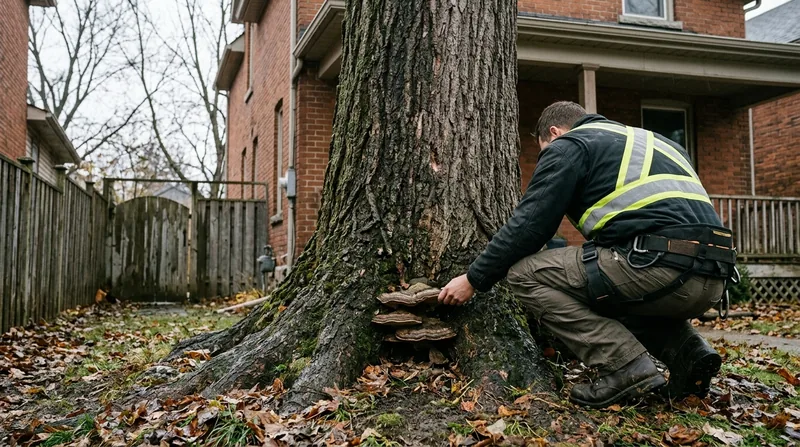




When a mature maple in your front yard starts thinning at the crown, or an oak on a ravine lot shows shelf fungus at the base, the problem rarely fixes itself. Tree disease treatment in Guelph starts with a proper diagnosis, not a guess. Our ISA Certified Arborists assess leaf diseases, cankers, root issues and internal decay across Guelph neighbourhoods, from West Willow Woods to Parkwood Gardens. We look at soil, drainage, recent construction and storm history before recommending anything. The goal is to keep a valuable tree standing when it can be saved, and to be honest when it cannot. For a free estimate, call (226) 829-5459 or review our pricing page for a sense of typical costs.
Why tree disease treatment matters in Guelph yards
Guelph sits on clay soils that hold water late into spring, and that alone stresses many species. Add a decade of drought-flood swings, ice storms and windstorms, and you get trees that are already weakened before a pathogen arrives. Ash killed by the emerald ash borer has left gaps in many canopies, exposing neighbouring trees to wind and sun they never had to handle. That is why a diagnosis-led approach matters more than a spray schedule.
- We identify whether the problem is infectious (fungal, bacterial) or environmental (drought, compaction, root damage).
- We check for secondary pests, including emerald ash borer galleries under the bark of ash trees.
- We assess structural risk before treating, because a hollow tree near a driveway is a safety issue first.
- We recommend treatment only where the tree has enough healthy tissue to respond.
In many cases, the right call is a targeted treatment plan combined with pruning and soil care rather than a single product.
Key fact: A sugar maple showing 30 percent crown dieback can often be stabilized with corrective pruning and mulching, while the same symptoms on a tree with root rot usually mean removal. Diagnosis changes the price by hundreds of dollars, which is why we inspect before quoting.
For official guidance on tree pests and invasive species in in Guelph and the surrounding area, the in Guelph and the surrounding area Ministry of Natural Resources forest health page is a useful reference.
How our arborists diagnose and treat a sick tree
A treatment plan is only as good as the inspection behind it. We walk the property, check the root flare, probe the trunk where decay is suspected, and look at the canopy from more than one angle. On ravine lots across the Guelph area, steep access means we often inspect from the slope side as well as the street side. From there we build a short, prioritized plan.
- We map the tree's location, species and exposure, including proximity to the house and private service entrance.
- We take note of soil conditions, drainage and any recent grading or construction within the root zone.
- We recommend a course of action: pruning, soil improvement, targeted injection, cabling, or removal if risk is too high.
- We document findings in writing so you can compare with another quote or support a permit application.
If the tree is an ash, we also check for emerald ash borer and discuss whether injection is still worthwhile.
Key fact: On a recent job in Centre Wellington, a red oak with crown dieback was kept standing after a pruning and mulching plan, while a nearby birch with similar symptoms turned out to have root damage from a patio build and had to come down. Same look, different outcome.
If the diagnosis points to a removal, our tree removal service handles the next step, and an arborist report can support the City of Guelph permit process when one applies.
Treatment methods we use
Not every sick tree needs the same approach. The table below shows the main methods we apply, and the situations where each one makes sense. We choose based on species, diagnosis and the risk the tree poses to people and property.
| Method | Description | Context |
|---|---|---|
| Corrective pruning | Removes dead, diseased and crossing branches to reduce stress and improve airflow. | Best in dormancy, late fall to late winter. |
| Soil improvement and mulching | Aerates compacted clay and adds organic matter around the root flare. | Useful after construction or drought stress. |
| Targeted injection | Delivers treatment directly into the vascular system for specific pests or diseases. | Emerald ash borer injection runs late spring to early summer. |
| Cabling and bracing | Adds structural support to weak unions or split leaders. | Common on mature maples and oaks near homes. |
| Removal and replacement | Takes down trees that cannot be made safe, then replants a suitable species. | Used when risk outweighs recovery chances. |
Each method has a season and a purpose, and we explain the trade-offs before any work begins.
What rules and practical limits apply in Guelph
Before any treatment or removal, we check what the City of Guelph requires. The City may require a permit for a private tree removal, and the application is normally supported by an arborist report. Rules and thresholds differ from one municipality to the next across the Guelph area, so we confirm the local requirement rather than assume. Near private electrical service entrances, we respect approach distances, and we never touch the public distribution network: a tree touching the public lines is referred to your local utility or Hydro One. Brush and wood from treatment work are chipped or removed according to the plan we agree on, and we leave the site clean.
For homeowners in Mapleton and Centre Wellington, the same discipline applies: local rules first, then the work. If you are comparing quotes, our arborist report service can give you the written documentation that a permit application usually needs.
When to book treatment in Guelph neighbourhoods
Timing affects both the diagnosis and the outcome. Pruning and structural work are best done in dormancy, from late fall to late winter, when the tree's energy is stored and the canopy is open. Emerald ash borer injection runs from late spring to early summer, when the tree is actively moving water. Emergency situations, including storm damage, happen year-round, with peaks after ice storms and summer windstorms. If you are unsure, book an inspection and we will tell you whether to wait or act now.
- Late fall to late winter: corrective pruning and structural assessment.
- Late spring to early summer: emerald ash borer injection and some disease treatments.
- Summer: storm damage assessment and emergency removals after windstorms.
- Any season: diagnosis, written reports and permit support.
Book early in the season if you want a specific window, because dormancy work fills up quickly in Guelph neighbourhoods.
For a broader look at how we handle tree work across the city, see our tree trimming service and our service areas page.
Prices Tree Disease Treatment in Guelph — Indicative pricing
| Service | Price | Details |
|---|---|---|
| Tree health inspection and written diagnosis | From $175 | On-site assessment with a written summary and recommendations |
| Corrective pruning for diseased or stressed trees | From $375 | Includes deadwood removal and canopy thinning where needed |
| Soil improvement and mulching plan | From $250 | Root zone aeration and organic mulch application |
| Emerald ash borer injection | From $275 | Per tree, late spring to early summer, based on trunk diameter |
| Cabling and bracing | From $450 | Structural support for weak unions on mature trees |
| Free estimate | Free | Call (226) 829-5459, response within 24 hours |
Indicative prices; free, personalized estimate within 24h at (226) 829-5459.