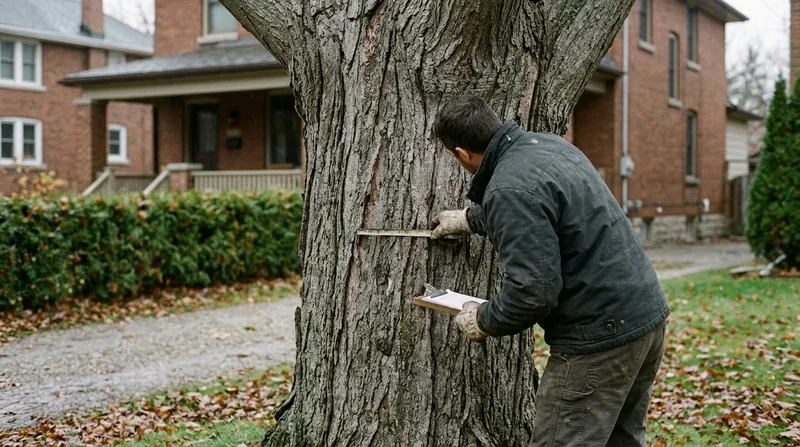




Arborist Report in Guelph: what the document actually does
An Arborist Report in Guelph is a written assessment prepared by an ISA Certified Arborist. It records the species, size, condition and location of every tree on a property, then sets out what can be removed, retained or protected during construction. Homeowners order one when the City of Guelph asks for supporting documentation on a private tree removal, when a renovation or addition moves within the root zone of a mature maple, or when a buyer wants to know what the silver maples along a ravine lot are worth. Our arborists have prepared these reports across Guelph since 2015, from post-war lots in West Willow Woods to tight backyards in Parkwood Gardens where the only access is a standard gate.
The report is a planning document, not a sales pitch. It gives the city, the builder, the insurer or the purchaser a defensible record, and it gives the owner a clear picture before any saw is started. If you are still at the stage of deciding what to cut, start with our tree removal service and we will tell you whether a report is needed.
Why an arborist report is often required before work starts
The City of Guelph may require a permit for a private tree removal, and the application is normally supported by an arborist report. Municipal rules and thresholds differ from one municipality to the next across the Guelph area, so a report written for a lot in Guelph is not automatically accepted in Centre Wellington or Mapleton. A report also protects the owner when a neighbour or an insurer later questions why a tree came down.
- The report identifies each tree by species, trunk diameter and crown spread, which is the first thing a reviewer looks for.
- It rates condition and structural defects, including decay, co-dominant stems and storm damage that a visual walk-by would miss.
- It maps root protection areas so excavators, driveways and additions stay clear of the critical root area.
- It documents emerald ash borer decline on ash, which is common on older residential streets in Guelph.
- It gives the owner a written record for property sales, insurance claims or contractor disputes.
Each of those points turns a verbal opinion into something a reviewer or a buyer can act on.
Key fact: A single mature sugar maple in a Guelph backyard can carry a replacement value in the thousands of dollars on a report. That figure is what an insurer or a purchaser reads, and it is why the inventory has to be accurate.
For the underlying rules, the City of Guelph publishes its tree protection and permit information at guelph.ca. Read it before you apply, because the bylaw wording is what the reviewer applies to your file.
How our arborists build the report
We treat the site visit as the core of the job. An ISA Certified Arborist walks the property, measures every tree that falls within the scope, and photographs defects from ground level and from the canopy where access allows. Nothing is copied from a template, because a ravine lot with steep access behind a house is a different document from a flat post-war yard with three street trees.
- We confirm the purpose of the report: permit application, development application, construction protection, insurance or pre-sale.
- We inventory the trees on site and record species, diameter at breast height, height, crown spread and condition rating.
- We note defects, disease and pest pressure, including emerald ash borer symptoms on ash and storm damage on older maples and oaks.
- We draft a tree protection plan with root protection areas and fencing specifications for the construction period.
- We deliver a signed PDF report with site plan, photo log and clear recommendations, and we answer questions from the city reviewer or the builder.
The result is a document that stands on its own, without the reader needing to call us to interpret it.
Key fact: On a recent lot in Onward Willow, the report identified a declining silver maple within 4 metres of a proposed addition. Moving the foundation 1.5 metres saved the tree and avoided a redesign later. That kind of finding is the reason the walk-through happens before the drawings are finalized.
If the report recommends retention and structural work rather than removal, the next step is usually our tree pruning service, which follows the same protection areas.
Report formats and when each one fits
Not every file needs the same level of detail. A pre-sale report for a homeowner in Guelph is shorter than a development application package for a ravine lot, and the difference shows up in the scope of the inventory and the depth of the protection plan. The table below sets out the formats we produce and the situations they serve.
| Format | Description | Context |
|---|---|---|
| Tree inventory report | Species, size, condition rating and location for every tree on the property. | Permit applications and pre-sale documentation. |
| Tree protection plan | Root protection areas, fencing layout and construction sequencing around retained trees. | Renovations, additions and new builds near mature trees. |
| Risk assessment | Target rating, defect analysis and recommended action for hazardous trees. | Storm damage, insurance files and neighbour disputes. |
| Development application package | Full inventory, impact analysis and mitigation plan tied to the site plan. | Severance, site plan and ravine lot applications across the Guelph area. |
Choosing the right format at the start avoids paying twice for a document that has to be redone.
What the report must respect on site
The document has to reflect the rules that apply where the tree stands, not a generic standard. In Guelph, a private tree removal may need a municipal permit, and the report is normally what supports the application. Approach distances must be respected near a private electrical service entrance, which means the wire running from the pole to the house. Any tree touching the public distribution network is referred to your local utility or Hydro One, and we never work on that network. Where a tree has to come down, the report notes how brush and wood will be handled, and our brush chipping service takes the material away in a clean, documented way.
Municipal requirements change from one municipality to the next across the Guelph area, so the report is written to the authority that will review it. For files where a tree has already failed, the same documentation supports our storm damage cleanup work, and it gives the owner a record of the damage for their insurer. We document the damage; we do not promise what an insurer will pay.
Residents comparing companies can check our pricing page for the range of report fees, and our contact page for booking a site visit. Reports start at $350 for a single-tree assessment and scale with the number of trees and the complexity of the site. For the wider region, see our service areas page.
Prices Arborist Report in Guelph — Indicative pricing
| Service | Price | Details |
|---|---|---|
| Single-tree assessment | From $350 | One tree, condition rating and written recommendation |
| Full property inventory | From $650 | Every tree on the lot: species, size and condition |
| Tree protection plan | From $850 | Root protection areas and fencing layout for construction |
| Development application package | From $1,200 | Full inventory, impact analysis and mitigation plan |
| Travel | Included | in Guelph and the surrounding area |
| Estimate | Free | Reply within 24 hours at (226) 829-5459 |
Indicative prices; free, personalized estimate within 24h at (226) 829-5459.