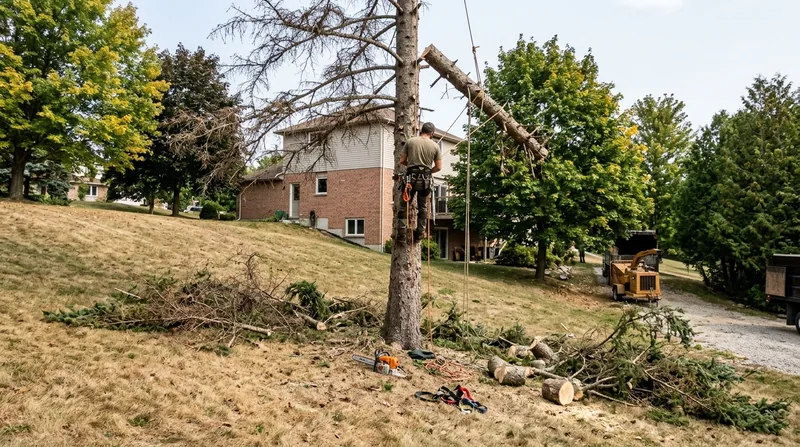




Tree Removal in Guelph is not a job for a ladder and a chainsaw. The city's mature canopy includes silver and sugar maple, red and white oak, ash killed by the emerald ash borer, birch, Norway spruce and black locust, and many of these trees now stand too close to roofs, fences and private service entrances. Guelph Tree Trimming Co. has taken down dead, dying and hazardous trees across the city since 2015, including tight backyards reachable only through a standard gate. Our ISA Certified Arborists assess the lean, the root flare and the target below before any cut is made. We rig sections down on ropes, protect the structures underneath and leave the property clean. For trees that are still sound, tree trimming is often the better first call.
Why a hazardous tree cannot wait
A dead ash or a split maple over a driveway is a liability that grows with every windstorm. in Guelph and the surrounding area's freeze-thaw cycles open cracks in the wood, and a tree that held through summer can fail under the first ice load of December. In Guelph's ravine lots, steep access makes the problem worse: a tree leaning over a slope can drop without warning onto a path, a shed or a neighbour's fence. Removal is the only safe answer once the structure is compromised.
- Dead or dying trees lose limbs without warning, especially ash hit by the emerald ash borer.
- Storm-damaged trunks may still be standing but have cracked roots or split crotches.
- Trees too close to the house rub shingles, block eavestroughs and drop debris on roofs.
- Diseased or leaning trees threaten fences, vehicles and private service entrance wires.
Each of these situations calls for an on-site assessment before anything is cut, because the removal plan depends on what stands underneath.
Key fact: A mature silver maple in a West Willow Woods backyard can weigh several tonnes and stand within 2 metres of a fence line. Removing it in one piece is not an option; it comes down in sections, and the rigging plan is set before the crew climbs.
Homeowners can check the City of Guelph's own guidance on private tree care and permits at guelph.ca before scheduling work.
How our crews take a tree down in Guelph
Every removal starts with a walk-around. We check the canopy for deadwood, the trunk for cavities and the ground for targets: roofs, fences, sheds, vehicles, private service entrance wires. The climber then sets a rigging line, and the ground crew lowers each section under control. Nothing is dropped free unless the drop zone is clear and measured.
- We confirm the property line and any municipal requirement before the first cut.
- We set ropes and rigging to lower limbs away from structures and fences.
- We section the trunk from the top down, keeping the drop zone controlled.
- We chip brush on site and haul away the wood, or cut it to length for firewood on request.
- We rake the work area and leave the lawn ready to use.
The same rigging discipline applies whether the tree stands in a front yard or at the back of a ravine lot with limited access.
Key fact: A Norway spruce in Centre Wellington, roughly 18 metres tall and leaning toward a garage, is typically taken down in six to eight rigged sections over a single day. The crew chips the brush, stacks the firewood and leaves the stump for grinding.
For stump work after the tree is down, see our stump grinding service.
Removal methods we use
The method depends on the tree's size, its lean and what sits underneath. A straight tree in an open yard can sometimes be felled in one piece; a tree over a roof or a fence cannot. Our arborists choose the least invasive method that gets the job done safely.
| Method | Description | Context |
|---|---|---|
| Sectional rigging | The climber cuts the tree in sections and lowers each one on ropes. | Tight backyards, trees over roofs or fences. |
| Directional felling | The tree is notched and felled in one piece into a clear drop zone. | Open lots, land clearing, trees with room to fall. |
| Crane-assisted removal | A crane lifts sections over structures when access is limited. | Large trees in dense neighbourhoods, ravine lots. |
| Storm damage stabilization | Broken limbs and split trunks are secured before removal. | After ice storms or summer windstorms. |
Each method is chosen on site, and the crew explains the plan before work begins.
What the rules require before a tree comes down
The City of Guelph may require a permit for a private tree removal, and the application is normally supported by an arborist report. Rules and thresholds differ from one municipality to the next across the Guelph area, so we check the local requirement before scheduling. Near private electrical service entrances, approach distances must be respected. A tree touching the public distribution network is referred to your local utility or Hydro One, and our crews never work on that network.
We document the site and the tree's condition, which helps if you need to file a report with your insurer. Brush is chipped on site, and wood is hauled away or cut for firewood at your request. For removals that need formal documentation, our arborist report service covers the assessment.
When removal is the right call in Guelph neighbourhoods
Not every problem tree needs to come down. Where the trunk is sound and the canopy can be rebalanced, pruning is cheaper and keeps the shade. Removal is the right call when the tree is dead, when the root plate has lifted, when the trunk is hollow at the base or when the tree has become a hazard to a structure. Our arborists give you that answer straight, not the most expensive option.
- We assess the tree's structure and the targets below before recommending removal.
- We explain the difference between a tree that can be pruned and one that cannot.
- We provide a written free estimate with the scope of work and the clean-up included.
If the tree can be saved, we say so and point you to the right treatment.
Emergency removals after an ice storm or windstorm
Storms in the Guelph area often leave trees partially down: a split trunk still standing, a limb through a roof, a tree resting on a fence. These are the calls we take year-round, and they peak with ice storms in winter and windstorms in summer. The first step is to make the site safe, then remove the damaged wood. We never send a crew near a wire that may still be live; that situation goes to your local utility or Hydro One.
For urgent work, call (226) 829-5459 and describe the situation. Our emergency tree removal service is set up for fast response, and our storm damage cleanup handles the debris once the tree is down.
What removal costs and what is included
Pricing depends on height, species, lean, access and what sits underneath. A small backyard tree is a different job from a 20-metre maple over a garage. We quote after seeing the site, and the estimate covers the crew, the rigging, the chipping and the haul-away. There are no surprise add-ons once the work starts. Our pricing page explains the factors we weigh.
Key fact: A 12-metre birch in a Parkwood Gardens backyard with gate access is a smaller job than a 20-metre oak in Onward Willow that needs rigging over a roof. Both are quoted on site, and both include brush chipping and wood removal.
Removal is often paired with brush chipping and, where the stump is in the way, stump grinding. For lots that need clearing before a build, see lot clearing.
Prices Tree Removal in Guelph — Indicative pricing
| Service | Price | Details |
|---|---|---|
| Small tree removal (under 10 metres) | From $450 | Includes rigging, brush chipping and hauling away |
| Medium tree removal (10 to 20 metres) | From $950 | Sectional rigging where access is tight |
| Large tree removal (over 20 metres) | From $1,800 | Crane or heavy rigging may be required |
| Emergency or storm-damaged removal | From $1,200 | Priority response, site made safe first |
| Stump grinding (add-on) | From $150 | Grinding depth and root flare included |
| Free estimate | Free | On-site assessment, response within 24 hours at (226) 829-5459 |
Indicative prices; free, personalized estimate within 24h at (226) 829-5459.