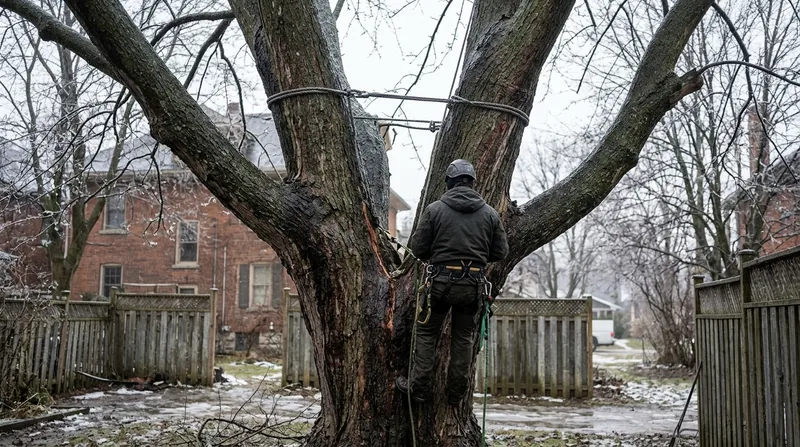




When a mature silver maple in West Willow Woods splits at the main fork after an ice storm, removing it is not the only answer. Tree cabling & bracing in Guelph gives sound trees a second life by installing flexible cables and steel rods in weak unions, co-dominant stems and long horizontal limbs. Our ISA Certified Arborists inspect the structure first, measure the load, then decide whether support hardware will actually reduce the risk. We have worked on ravine lots, post-war street trees and tight backyards across the city since 2015. If you are comparing options, start with our tree pruning service to see how structural work fits together.
Why structural support matters on mature trees
Older maples, oaks and ash across the Guelph area carry defects that are not always visible from the ground. A narrow fork, included bark, a cavity at the base of a limb or a previous poor prune can turn a summer windstorm into a split trunk. Cabling and bracing do not heal the tree; they reduce the movement that causes failure.
- We inspect the crown, the root flare and the main unions before recommending any hardware.
- We identify co-dominant stems that are likely to split under snow or ice load.
- We check for included bark, decay and cracks that change the way a cable should be installed.
- We document the tree's condition so you can track changes over the following seasons.
Support hardware buys time and reduces risk, but it only works when the tree is healthy enough to keep. Trees with more than 30 percent crown dieback or advanced root decay are usually better candidates for removal.
Key fact: a single cable installation on a 45 cm silver maple in Parkwood Gardens typically runs from $450 to $750, depending on height, access and the number of unions to support. Two or three cables on a large ravine-lot oak can reach $1,200.
How we install cables and rods
Every installation starts with a climb and a close inspection. We do not quote support hardware from the driveway. An arborist goes up, checks the wood, measures the span between limbs and confirms that the anchor points are in sound tissue. Only then do we set the hardware.
- We assess the tree from the ground and from within the crown, noting cracks, cavities and included bark.
- We select the anchor points, usually about two-thirds of the distance from the weak union to the tips of the limbs.
- We install through-bolts or steel rods where a union needs rigid support, and flexible steel cables where movement must be limited.
- We tension the system so the limbs cannot spread beyond a safe angle under wind or snow load.
- We record the hardware type, location and installation date, and schedule a follow-up inspection.
Hardware is inspected every two to three years, and after any major ice storm or windstorm. A cable that has lost tension or a rod that has moved needs attention before the next winter.
Real example: in Onward Willow, a 60 cm sugar maple with a split fork over a driveway was cabled with two 8 mm steel cables and one through-rod. The work took half a day, the tree stayed, and the homeowner avoided a removal quote that started at $2,800.
Cabling, bracing and the alternatives
Not every weak tree needs the same solution. The table below shows the methods we use most often in Guelph and the situations where each one fits. We choose based on species, wood condition, access and the load the tree carries.
| Method | Description | Context |
|---|---|---|
| Dynamic cable | Flexible steel cable that limits limb spread while allowing natural movement. | Best for long horizontal limbs on oak and maple in open yards. |
| Static cable | Tensioned cable that holds two stems at a fixed distance. | Used on co-dominant stems with included bark where movement must be stopped. |
| Through-rod | Steel rod installed through a union to prevent splitting. | Suited to narrow forks on mature ash and maple near structures. |
| Crown reduction | Selective pruning that lowers the load on a weak union before hardware is added. | Common on ravine lots where the tree leans toward a house or deck. |
| Removal | Taking the tree down when the defect is too advanced for support. | Recommended when more than 30 percent of the crown is dead or the roots are compromised. |
Each option has a cost and a lifespan. We explain both before any work begins, so you can decide whether to keep the tree or plan for its removal.
Permits, setbacks and cleanup in Guelph
Support work does not usually require a municipal permit, but the tree itself may be protected. The City of Guelph may require a permit for a private tree removal, and the application is normally supported by an arborist report. If your tree is on a ravine lot or in an older neighbourhood with mature street trees, check the rules before any major pruning. We can prepare the documentation if the city asks for it.
Safety setbacks also matter. Work near the private electrical service entrance must respect approach distances, and any tree touching the public distribution network is referred to your local utility or Hydro One. We never work on that network. All brush and wood from the job is chipped or removed the same day, and we leave the yard clean.
For a closer look at how we handle structural pruning before hardware goes in, see our deadwood removal service. If the tree turns out to be too far gone, our tree removal page explains the next step, and our arborist report service covers the paperwork the city may request. For pricing across all services, check the full price list or contact us for a free estimate.
Prices Tree Cabling & Bracing in Guelph — Indicative pricing
| Service | Price | Details |
|---|---|---|
| Single cable installation | From $450 | One flexible or static cable in a weak union includes inspection and cleanup |
| Two to three cables | From $750 | Multi-point support for large co-dominant stems or long limbs |
| Through-rod installation | From $550 | Rigid support for a narrow fork or split union |
| Cable and rod combined | From $950 | Full system for a mature tree with several defects |
| Follow-up inspection | From $150 | Tension check and hardware review, recommended every two to three years |
| Free estimate | Free | On-site assessment, response within 24 hours at (226) 829-5459 |
Indicative prices; free, personalized estimate within 24h at (226) 829-5459.