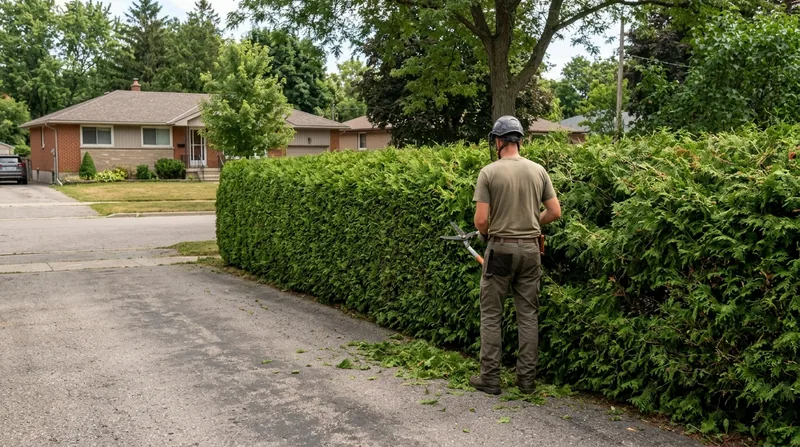




Cedar hedge trimming in Guelph is not a cosmetic chore you squeeze in when the hedge starts swallowing the walkway. A cedar hedge is a living wall, and how you cut it decides whether it stays dense to the ground for the next fifteen years or goes bare and leggy from the inside out. Our crews trim cedar hedges across Guelph and the surrounding municipalities, from the tight property lines of post-war subdivisions to the sloping lots that back onto a ravine. We cut straight lines, square faces and a slight taper at the top so daylight reaches the lower branches. Every clipping leaves with us. If you are comparing two or three companies, this page explains what the work involves, when to book it and what drives the price.
We have run cedar hedges in this city since 2015, and the same pattern shows up on most streets: hedges planted decades ago, never shaped properly, then cut back hard in one pass. That single hard cut is what turns a healthy cedar screen into a brown, patchy fence. We work gradually instead. For a broader look at how we handle woody plants on a property, see our tree pruning service in Guelph.
Why a cedar hedge needs a proper trim, not a haircut
Cedar responds to light. Cut the face of a hedge flat and vertical, and the top receives most of the sun while the lower section slowly thins out. A slight taper, narrower at the top than at the base, keeps light on the bottom third and holds the screen full to the ground. The other common mistake is removing too much green wood in one season. Cedars do not push new growth reliably from old bare branches, so a hedge that is cut back into the brown interior often stays brown.
Our ISA Certified Arborists assess the hedge before any cut is made. We check the species, the density, how much live growth sits behind the face, and whether the hedge sits on a property line shared with a neighbour. That assessment drives the plan:
- We establish a string line so the face runs straight over its full length.
- We set the taper at the top to keep light on the lower branches.
- We remove no more than the hedge can recover from in one season.
- We clear the base of debris so air moves through the lower section.
- We collect every clipping and remove it from the property.
A hedge trimmed this way holds its shape through the summer and needs less corrective work the following year.
Key fact: A 30 metre cedar hedge along a property line in a Guelph subdivision typically takes one crew most of a day to shape, clean and clear. A hedge that has not been cut in five years can take longer because we remove the overgrowth in stages rather than all at once.
For the rules that apply to trees and hedges on private property in in Guelph and the surrounding area, the provincial government publishes plain-language guidance at ontario.ca.
How we bring an overgrown cedar hedge back into line in the Guelph area
Most of the hedges we are called to have been left for three to five years. The face has bulged, the top has gone uneven and the bottom has started to thin. Cutting that hedge back to a perfect wall in one afternoon would strip too much live growth and leave a brown band across the middle. We work in stages instead, and we tell you at the estimate how many seasons the recovery will take.
On a recent job in Parkwood Gardens, a 25 metre cedar hedge had grown out over a driveway and was pressing against a fence. We reduced the face by roughly a third, squared the top, kept the taper, and returned the following season to finish the line. The hedge stayed green through the lower section because we never cut past the live growth.
The sequence we follow on every hedge:
- We walk the hedge with you and confirm the finished height and the line you want.
- We set string lines on the face and the top before the first cut.
- We trim the sides first, then the top, so the shape stays true.
- We check the lower section for dead material and clear it out.
- We rake and blow the work area, then haul all clippings away.
If the hedge sits on a boundary you share with a neighbour, we can mark the line with you before we start so there is no dispute afterwards. For work that involves removing a hedge entirely, our tree removal service in Guelph covers the extraction and the stump.
Key fact: A cedar hedge that has gone bare in the middle will not green up again from the inside. If more than about a third of the depth is brown, we discuss replacement of that section rather than promising a recovery that will not happen.
Trimming methods we use on cedar hedges
The right method depends on the height of the hedge, the space around it and how much growth has to come off. A low hedge along a front walk can be finished with hand shears. A three metre screen between two houses needs powered equipment and a plan for the clippings. The table below sets out what we use and when.
| Method | Description | Context |
|---|---|---|
| Hand shearing | Manual shears follow the string line and give a clean face on short runs. | Hedges under 1.5 metres and detailed corners around walkways. |
| Powered hedge trimmer | A sharpened blade cuts cleanly through green growth without tearing the tips. | Long property-line hedges and screens up to about 2.5 metres. |
| Staged reduction | We take the overgrowth down over two or three seasons instead of one hard cut. | Hedges left uncut for years that have bulged well past the line. |
| Tapered top cut | The top is left slightly narrower than the base so light reaches the lower branches. | Every hedge we shape, particularly tall screens that shade their own base. |
| Clipping removal | We bag or chip the clippings and take them off the property the same day. | All jobs, including tight backyards reached through a standard gate. |
Whichever method we use, the finished line is checked against the string before we leave, and the ground is cleared of every clipping.
What surrounds the work: permits, boundaries and cleanup
Cedar hedge trimming on private property generally does not require a municipal permit, but the rules are not identical from one municipality to the next across the Guelph area. The City of Guelph may require a permit for a private tree removal, and where a hedge removal forms part of a larger tree plan, an arborist report is normally what supports the application. If your project touches protected trees as well as the hedge, we can prepare that documentation. Our arborist report service covers the assessment and the paperwork.
Two practical points come up on almost every job. First, if the hedge runs along a shared property line, confirm with your neighbour where the boundary sits before cutting; we can mark it with you on site. Second, if any part of the hedge is close to the wire that runs from the pole to your house, we respect the required approach distances and plan the cut around that private service entrance. The public distribution network is never touched by our crews: a branch or hedge section in contact with those lines is referred to your local utility or Hydro One.
All clippings leave with us. We do not leave piles at the curb for a later pickup, and we do not blow debris onto a neighbouring lot. On tight properties where the only access is a standard gate, we carry the clippings out by hand.
When to book cedar hedge trimming in Guelph neighbourhoods
Cedar hedge trimming is best done in late spring and summer, once the new growth has flushed and the hedge is actively growing. Cutting at that point lets the hedge close the cut tips before dormancy. Structural work on the trees around the hedge, by contrast, is best done in dormancy from late fall to late winter. That split matters on a property where both jobs are needed: we can schedule the tree work for the winter and the hedge for the summer.
Summer also brings the calls that follow a windstorm, when a hedge has been pushed out of line or a section has split. Those repairs are handled case by case, and we will tell you honestly whether the section can be re-tied and shaped or whether it needs replacing. If a storm has brought down more than the hedge, our storm damage cleanup service handles the wider cleanup.
Book early in the season. The window from late May through August fills quickly across Guelph, Centre Wellington and Mapleton, and a hedge that is booked in June is usually finished before the hottest stretch of July.
Key fact: A cedar hedge trimmed in late June in the West Willow Woods area typically holds its line until the following spring. A hedge cut in early May, before the new growth has flushed, often looks uneven within weeks because the fresh tips grow past the cut line.
What drives the price of a hedge trim
Three things set the price: the length of the hedge, its height, and how much growth has to come off. A short front-yard hedge cut once a season sits at the low end. A tall screen that has been left for years, with clippings that have to be carried out through a gate, sits at the high end. We quote after seeing the hedge, not over the phone, because a photo rarely shows how much live growth sits behind the face.
Our pricing page sets out the ranges we work within. For a firm number, book a free estimate and we will walk the hedge with you and confirm the finished height and line on the spot. You can reach us at (226) 829-5459 or through our contact page.
We are a local, fully insured company, and our ISA Certified Arborists are on staff. That matters when a hedge sits near a fence, a driveway or a service entrance, and when you want a straight answer about whether a hedge can be saved or should be replaced.
Prices Cedar Hedge Trimming in Guelph — Indicative pricing
| Service | Price | Details |
|---|---|---|
| Cedar hedge trimming, low hedge (under 1.5 m) | From $200 | Hand shearing, string line, clippings removed |
| Cedar hedge trimming, standard screen (1.5 to 2.5 m) | From $350 | Powered trimmer, squared face, tapered top |
| Cedar hedge trimming, tall screen (over 2.5 m) | From $550 | Staged cut where needed, full cleanup |
| Overgrown hedge restoration | From $700 | Gradual reduction over one or more seasons |
| Travel | Included | In Guelph and the surrounding area |
| Estimate | Free | Reply within 24 hours at (226) 829-5459 |
Indicative prices; free, personalized estimate within 24h at (226) 829-5459.