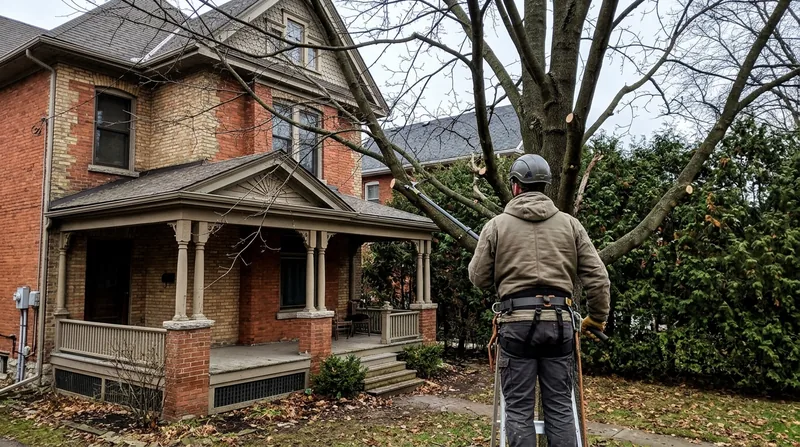




Homeowners across Guelph call us when a maple has started to shed limbs over the driveway, when a young oak is growing a weak fork that will split under ice, or when a mature ash is declining and needs a careful assessment before anything else happens. Tree pruning in Guelph is selective work: we remove deadwood, weak unions and rubbing branches, and we train young trees early so they build a structure that holds up to snow, ice and summer windstorms. Our ISA Certified Arborists work from a free estimate, document the condition of the tree, and leave the property clean. We have been doing this since 2015. For the full picture of what we offer, start with our tree trimming service.
Why pruning matters for trees in Guelph
Guelph's tree cover is a mix of silver and sugar maple, red and white oak, birch, Norway spruce and black locust, with ash killed by the emerald ash borer still standing on many lots. Add lake-effect snow, freeze-thaw cycles and summer windstorms, and a weak union or a rubbing branch becomes a real hazard. Pruning removes the problem before it fails.
- We remove deadwood before it drops onto roofs, fences and parked cars.
- We correct weak unions and co-dominant stems while the tree is still young enough to respond.
- We thin the crown where branches rub and open wounds for decay.
- We clear branches away from the private service entrance to your house, respecting approach distances.
- We assess ash for emerald ash borer damage and recommend the right next step.
Each visit starts with a walk-around, so the work matches what the tree actually needs rather than a fixed package.
Key fact: A mature silver maple in a post-war subdivision off West Willow Woods can carry several hundred kilograms of deadwood after a decade without pruning. Removing it in dormancy costs far less than the repairs after one ice storm.
For the rules that apply to trees on private property in in Guelph and the surrounding area, see the in Guelph and the surrounding area Ministry of Natural Resources and Forestry.
How our crews prune a tree
We climb or use a lift depending on access, and we work to ANSI A300 pruning standards. Tight backyards reachable only through a standard gate get the climbing crew; ravine lots with steep access across the Guelph area get a site plan before anyone leaves the shop. Every cut is made with the tree's response in mind.
- We inspect the tree and note deadwood, cracks, weak forks and clearance issues.
- We set a drop zone and protect lawns, gardens and fences before cutting.
- We make reduction and removal cuts at the branch collar so wounds close cleanly.
- We chip the brush on site and leave the firewood or haul it away as you prefer.
- We rake the work area and walk the property with you before we leave.
The result is a tree that keeps its shape, sheds less, and stands up better to the next storm.
Key fact: A cedar hedge along a property line in Centre Wellington is usually trimmed in late spring or summer, while structural pruning on the maples and oaks behind it is scheduled for dormancy. Mixing the two schedules is how hedges get scalped and trees get stressed.
If the brush volume is large, see our brush chipping service for on-site disposal.
Pruning methods we use
The right method depends on species, age, access and what the tree is being asked to do. A young sugar maple in a front yard needs training; a mature oak over a driveway needs crown reduction and deadwood removal. We choose the method on site, not over the phone.
| Method | Description | Context |
|---|---|---|
| Crown cleaning | Removal of dead, dying, broken and rubbing branches. | Mature maples and oaks with accumulated deadwood. |
| Crown thinning | Selective removal of interior branches to improve light and airflow. | Dense crowns on birch and Norway spruce. |
| Crown reduction | Cutting back to a lateral branch to lower height or spread. | Trees crowding a roof or the private service entrance. |
| Structural training | Early cuts that establish a single leader and strong unions. | Young street trees in post-war subdivisions. |
| Deadwood removal | Targeted removal of hazardous limbs over structures and walkways. | Ash killed by emerald ash borer and storm-damaged trees. |
We match the method to the species and the site, and we explain the choice before any cut is made.
Permits, clearances and cleanup
Pruning itself rarely needs a permit, but the City of Guelph may require a permit for a private tree removal, and that application is normally supported by an arborist report. Rules and thresholds differ from one municipality to the next across the Guelph area, so we check before we schedule. Near hydro lines, we work only on clearance around your private service entrance and respect approach distances; a tree touching the public distribution network is referred to your local utility or Hydro One. Brush is chipped on site, firewood can be left for you, and the rest is hauled away.
If the work uncovers a structural problem, we can recommend tree cabling and bracing to support a weak union rather than remove the tree. For a written assessment to support a permit application, see our arborist report service. Our pricing page lists typical ranges, and our contact page is the fastest way to book a free estimate.
Prices Tree Pruning in Guelph — Indicative pricing
| Service | Price | Details |
|---|---|---|
| Small ornamental tree pruning | From $225 | Up to 6 metres, crown cleaning and shaping |
| Medium tree pruning | From $475 | 6 to 12 metres, deadwood removal and crown thinning |
| Large mature tree pruning | From $850 | Over 12 metres, climbing or lift access, disposal included |
| Fruit tree pruning | From $275 | Seasonal structural pruning for fruit production |
| Complex or high-access job | On estimate | Ravine lots, tight gates and steep access, free on-site assessment |
| Free estimate | Free | Reply within 24 hours at (226) 829-5459 |
Indicative prices; free, personalized estimate within 24h at (226) 829-5459.