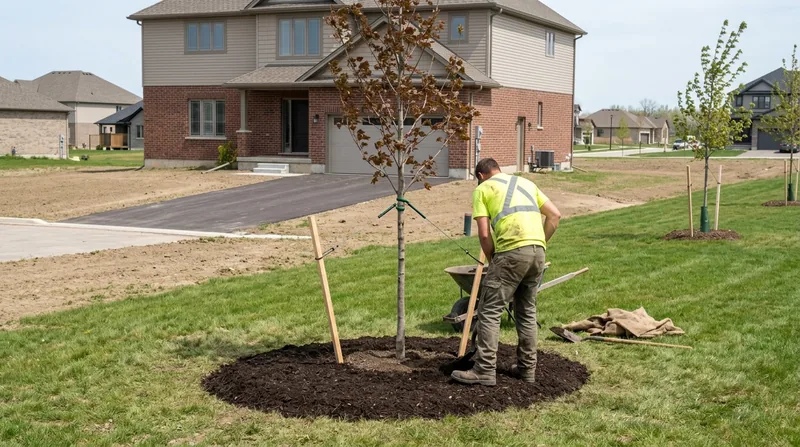




Choosing the right tree for a Guelph yard starts with the soil, the light and the space the tree will occupy in twenty years. Tree Planting & Transplanting in Guelph is not a matter of digging a hole and dropping in a sapling: it is a decision about species, root depth, drainage and the mature canopy that will one day shade your roof or crowd your service entrance. Our ISA Certified Arborists have planted and moved trees across Guelph since 2015, from ravine lots with steep access to tight backyards reachable only through a standard gate. We select hardy and native species suited to in Guelph and the surrounding area clay and freeze-thaw cycles, set them at the correct depth, and stake only when the site demands it. Whether you are replacing an ash lost to the emerald ash borer or transplanting a mature specimen, the work is planned around the right season. For background on how we assess existing trees before a planting plan, see our tree pruning service.
Why planting and transplanting needs a plan, not a shovel
A tree planted too deep will girdle itself within a decade, and one placed under hydro lines or too close to a foundation becomes a removal cost later. In Guelph, the combination of heavy clay, winter salt and summer drought stress makes species selection decisive. We match the tree to the site before anyone breaks ground, and we document the planting for your records.
- We evaluate soil drainage, compaction and pH before recommending a species.
- We check the planting location against overhead wires and the private service entrance.
- We confirm the mature height and spread against the space available.
- We source nursery stock grown for in Guelph and the surrounding area hardiness areas.
- We set the root flare at grade, never below it.
That upfront assessment prevents the most common and most expensive planting mistakes we are called back to correct.
Key fact: A 2 metre Norway spruce planted 3 metres from a Guelph foundation will reach the eaves within fifteen years. Moving it later costs several times the original planting, which is why we measure the mature spread, not the sapling, before we dig.
For municipal guidance on tree care and planting near public infrastructure, the City of Guelph publishes homeowner resources at guelph.ca.
How we plant and transplant in the Guelph area
Every planting follows the same sequence, whether we are setting a single sugar maple in a front yard or moving a mature specimen from a ravine lot. The sequence protects the root system, which is the part of the tree most often damaged by careless handling. Transplanting a tree with a full root ball requires the right season and the right equipment, and we plan both before the crew arrives.
- We mark the planting location and call for utility locates before digging.
- We excavate a saucer-shaped hole two to three times the width of the root ball.
- We lift the tree by the root ball, never the trunk, and set it at the correct depth.
- We backfill with native soil, water to settle, and mulch without touching the trunk.
- We stake only where wind exposure or loose soil requires it, and we plan the removal date.
Each step is recorded so the homeowner knows what was planted, where, and how to water it through the first two summers.
Key fact: On a ravine lot off a Guelph neighbourhood street, we moved a 4 metre sugar maple with a 90 centimetre root ball in early April. The tree was lifted by machine, replanted within the hour, and staked for one season. It leafed out fully the same spring.
If a planting plan requires removing a failing tree first, our tree removal service coordinates directly with the planting schedule.
Planting methods we use
The method depends on the size of the stock, the access to the site and the season. A bareroot sapling in a parkway strip is a different job from a balled-and-burlapped specimen behind a gate. We choose the method that gives the root system the best chance, not the one that is fastest for the crew.
| Method | Description | Context |
|---|---|---|
| Bare root planting | Dormant stock with soil removed from the roots, planted in early spring. | Best for small to medium deciduous trees and tight budgets. |
| Balled and burlapped | Root ball wrapped in burlap and secured with twine or a wire basket. | Standard for nursery stock up to 3 metres, planted spring or fall. |
| Machine-assisted transplant | A tree spade lifts and moves a mature tree with its full root ball. | Used when a specimen must be relocated within the property. |
| Container planting | Potted stock with the root mass scored before planting. | Suited to small conifers and shrubs where the season runs late. |
Choosing the right method for the site is what separates a tree that establishes in two years from one that struggles for ten.
What governs a planting or transplant in Guelph
Before any work begins, we check whether the City of Guelph may require a permit for a private tree removal, since a transplant or a replacement planting often follows one. The application is normally supported by an arborist report, and our staff prepare that documentation when it is needed. Rules differ from one municipality to the next across the Guelph area, so we confirm the local requirement rather than assume it.
Safety distances matter as much as paperwork. We respect approach distances near the private electrical service entrance, and any tree touching the public distribution network is referred to your local utility or Hydro One. Our crews never work on the public network. Soil, mulch and debris are removed from the site at the end of the job, and surplus topsoil is either spread on site or hauled away according to the homeowner's preference.
Species that perform in Guelph soils
The right tree for a Guelph yard is one that tolerates clay, survives freeze-thaw and resists the pests already present in the area. Silver and sugar maple, red and white oak, birch and black locust all perform well when the site is matched to the species. Norway spruce suits windbreaks and larger lots, while cedar hedges remain the standard for property lines across Guelph neighbourhoods.
- Sugar maple suits larger yards with consistent moisture and space for a broad canopy.
- Red oak establishes slowly but lives long and tolerates compacted urban soil.
- Birch needs cool, moist ground and does not tolerate drought on exposed sites.
- Black locust fixes nitrogen and grows fast on poor, dry soil.
- Norway spruce provides a dense evergreen screen where space allows.
We avoid planting ash unless the homeowner accepts an ongoing treatment program, given how widely the emerald ash borer has spread through the area.
Key fact: A homeowner in Parkwood Gardens replaced two ash lost to the borer with a red oak and a sugar maple, planted 6 metres apart to allow for mature spread. Both were set at grade with mulch rings and watered through two summers. The replacement cost was a fraction of what a later removal would have been.
Aftercare that decides whether the tree survives
Planting is the first day of a ten-year relationship. Watering through the first two summers matters more than any fertilizer, and mulch should stay clear of the trunk to prevent rot and rodent damage. We leave written aftercare instructions with every planting and return for a check in the first season.
Structural pruning in the first decade shapes a tree that will not need corrective work later. That work is best done in dormancy, late fall to late winter, when the tree is not spending energy on leaves. For larger specimens, our cabling and bracing service supports weak unions that develop as the canopy fills out.
Homeowners who want a full picture of costs before committing can review our pricing page, and we confirm every figure on site before work begins.
Prices Tree Planting & Transplanting in Guelph — Indicative pricing
| Service | Price | Details |
|---|---|---|
| Bare root or container sapling planting | From $225 | Single tree up to 2 metres, hole prepared, staked if needed, mulch ring included |
| Balled and burlapped tree planting | From $475 | Nursery stock up to 3 metres, machine lift where access allows |
| On-site transplant with root ball | From $850 | Mature specimen moved within the property, season dependent |
| Multi-tree planting plan | From $1,275 | Three trees or more, species selection and layout included |
| Site visit and planting assessment | Free | Species, soil and location review in Guelph and the surrounding area |
| Written estimate | Free | Response within 24 hours at (226) 829-5459 |
Indicative prices; free, personalized estimate within 24h at (226) 829-5459.